


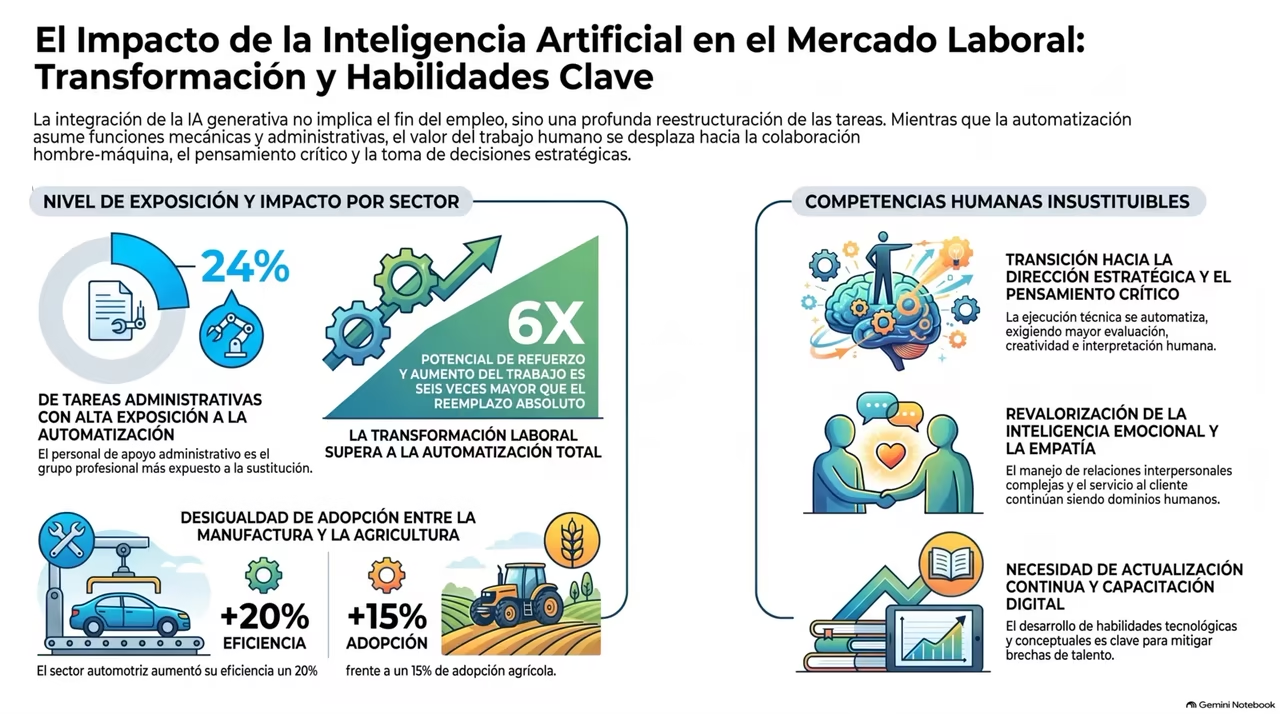
There is a widespread panic online about how artificial intelligence will destroy every job. But when you look at the real data, the picture is different — and fascinating: this is not a jobs apocalypse, it is the biggest reconfiguration of tasks in modern history.
What the data says.
The International Labour Organization (ILO) showed that AI's potential to reinforce and transform human work is almost six times greater than its potential to replace it: a 13% reinforcement impact versus 2.3% pure automation. [1][6]
From doing the technical work to leading the concept.
Routine work gets automated so the brain is free for what we do best: create, think critically and lead. [1]
- In the creative sector: generative AI can automate up to 26% of repetitive tasks in design, art and media. In fact, 75% of creative professionals already use it as a facilitating tool for research and editing. The centre of gravity has shifted: it is no longer about spending ten hours tweaking software, but about mastering strategic thinking and directing ideas. [2]
- In traditional industries and services: in the legal sector, LegalTech and algorithms optimise contract and case management, shifting human work towards ethical judgement and auditing. Meanwhile, in manufacturing and logistics, companies have raised operational efficiency by up to 20% in automotive and cut delivery times by 30% with predictive analytics. [4][5]
The real superpower: human adaptability.
Professions are not disappearing; they are changing level. Administrative support tasks are the most exposed to basic process automation. That is why staying exactly where you were five years ago is the only real risk. [3][8]
More than 120 million workers are estimated to need reskilling to adapt to this new era. [3] The essential skills:
- Critical thinking and ethical judgement: evaluating what the machine produces.
- Working with models (prompt engineering): communicating clearly in natural language.
- Emotional intelligence and leadership: purely human, irreplaceable skills. [7][8]
The message is clear.
AI is not going to replace humans. But humans who learn to use AI will replace those who do not. Technology is an incredible copilot, but the captain of your career is still you.
The future belongs to those who take the initiative today.
— Jacques Hauzeur
Never stop learning.
References.
- ILO — Generative AI and jobs: a global analysis of potential effects on job quantity and quality (ILO Working Paper 96, 2023).
- UOC — How AI changes professions like design, art and media.
- Infobae Tecno — AI reconfigures thousands of jobs and challenges traditional skills.
- AIEP — How artificial intelligence is transforming work.
- Derecho y Realidad (UPTC) — AI in the legal sector: professionals and a comparative analysis with Spain.
- RIMI — The impact of artificial intelligence on the labour market.
- OTRS — The most important skills for the AI era.
- Coomeva Blog — Artificial intelligence at work: the future of professions.
- Coderhouse — Integrating AI at work: a step-by-step guide with no code.